
Why Does Adding Electricity to Dry Needling Make It More Effective?
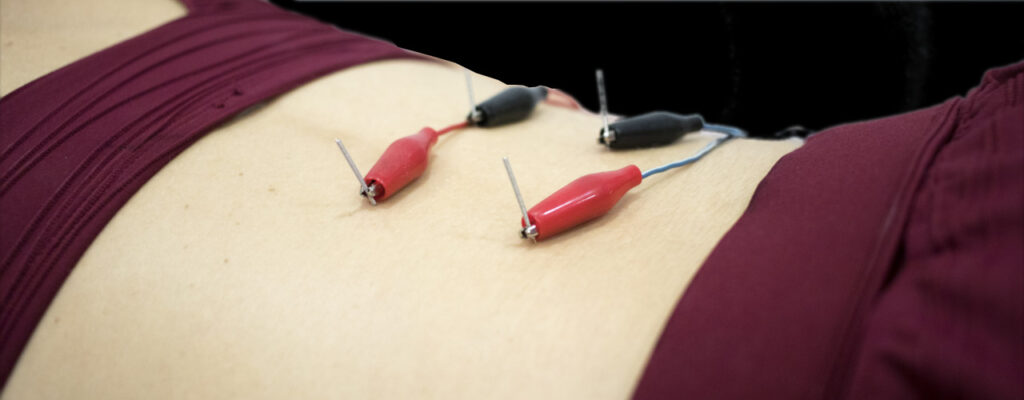
If you have received dry needling in the past few years, there’s a chance that the therapist attached alligator clips to a pair of the needles and sent an electrical current between the needles. You probably asked, “what does that do”, and the therapist gave you a vague answer, because honestly, we don’t learn a lot about how it works, just that it works. Today I will answer that question.
What is PENS?
The technical name for adding electricity to dry needling is Percutaneous Electrical Nerve Stimulation (PENS). There are several different parameters you can adjust when performing PENS (frequency and amplitude are the big ones), which I will cover in my next blog post. Today, I will focus on three mechanisms of action of PENS: effects on the nerves, muscles, and lymphatic system.
How does PENS work?
The first effect is the effect on the nerves. When an electrical current is sent between the needles, the electrical pulses block the transmission of the pain signal from the nerve fibers to the brain. You have multiple types of nerve fibers, and in general, painful sensations travel on the slower fibers and non-painful sensations travel on the faster fibers. When you injure a body part, there are typically very few stimuli that compete with the painful signal that is being sent to the brain. However, when a non-painful electrical signal is added into the mix, it can outcompete the painful signal and decrease the overall amount of pain that the brain perceives.
Another mechanism by which PENS works is by increasing blood flow and oxygen levels in the area between the needles; these effects will only be seen if a muscle contraction is obtained during the treatment. When a muscle contracts, even if it is done passively (i.e. the electricity causes the movement instead of you actively contracting the muscle), the contraction is caused by a chemical response in the muscle, not by the electrical signal itself. This is a little complicated, so I’ll break it down. When an electrical signal traveling down a nerve reaches a muscle, it interacts with a part of the muscle called the motor end plate (MEP). Think of the MEP as having 3 parts: the end of the nerve, the beginning of the muscle, and a space between these two. When the electrical signal reaches the end of the nerve, aka the beginning of the MEP, it triggers a release of chemicals from the end of the nerve. These chemicals then travel through the open space to the beginning of the muscle, which causes a release of calcium. This release of calcium then triggers the contraction of the muscle, which requires oxygen to perform.
I describe this entire process because the role of oxygen is very important. In my last blog post I mentioned the fact that one reason people experience chronic pain is because of decreased blood flow to the painful area. When you repetitively contract a muscle, the available oxygen is depleted, and this depletion of oxygen acts as a signal to the brain to flood this area with oxygen (via increased blood flow), which eliminates, or at least alleviates, the problem of decreased blood flow. Short, repetitive contractions, like those experienced with PENS, are very effective at depleting oxygen in the contracting muscles and causing this overcompensation.
One last mechanism: repetitive muscle stimulation helps remove swelling from the treated area. There is a system of vessels within your body that run parallel to the blood vessels but are separate from it; this system is called the lymphatic system. The lymphatic system is responsible for carrying excess fluids (think swelling) from the entirety of the body back to the core, where it is recycled. Unlike your blood vessels, which typically have a muscular wall that helps propel blood through them, the lymphatic system has no such system and relies on muscle contraction for the movement of this fluid. This is typically not a problem, since we as people usually move a lot, but if you’re injured it’s a different story. Let’s say you hurt your bicep. It’s incredibly painful to use that muscle, so you stop moving it as much as possible. As a result, all of the fluid that is traveling to that region to deliver helpful nutrients to the bicep will get stuck there, since there is no muscle contraction to help pump it back to your core, which then impedes the ability of additional fluid to come to the area. Now you have a logjam that is preventing the delivery of additional healing compounds. One way to get this fluid moving through the lymphatic system is to use PENS, since it creates (typically) non-painful muscle contractions that get fluid moving through the lymphatic system again.
Summary
PENS works through 3 main mechanisms: it blocks the transmission of pain signals to the brain; causes muscular contractions, which improves blood flow and local oxygen levels; and stimulates the lymphatic system, which helps remove swelling from the injured area.
Western Slope Rehab and Performance is Here to Help
If you are struggling with injuries or have recently been in a motor vehicle accident, we can help. We are a physical therapy company that provides home-based orthopedic services in the Grand Junction, CO, area, as well as telehealth appointments throughout Colorado. If you would like to schedule a free consultation, you can call us as 970-462-9177, or fill out our contact form here.
If you found this post valuable, please like and share on our Facebook page, which is updated regularly with new content.