

What is Sciatica and How Do I Get Rid of It?

Sciatica is one of the most common injuries experienced nationwide and is especially common after a car accident. This pain typically feels like a burning or pins and needles sensation down the back of the leg and can be very debilitating. In this post, we will discuss the anatomy of the sciatic nerve, what can cause sciatica, and what you can do about it.
Sciatica Anatomy
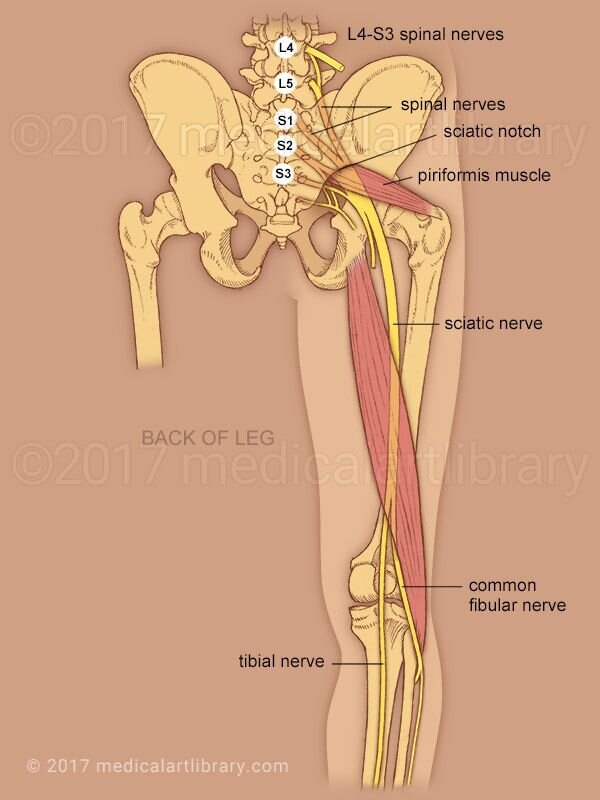
While the pain from sciatica is most commonly experienced in the leg, the nerve itself has its origins in the back. The sciatic nerve is composed of 5 different nerves coming out of your spine, L4 to S3 (description here), which converge around your hip into the sciatic nerve. The sciatic nerve then travels down the back side of the leg and into the foot. Along this course, the nerve splits several times and changes names, becoming the tibial nerve, common fibular nerve, and medial and lateral plantar nerves, among others.
There is one important muscle to mention here: the piriformis. The piriformis begins on the outside of the tailbone, or sacrum, travels laterally, and attaches onto the outside of the hip. The sciatic nerve is intimately connected with this muscle. In fact, some people’s sciatic nerve actually goes through the piriformis, making it more likely that they will develop sciatica symptoms.
What is Sciatica
All this naming can be confusing, but the most important issue is that it is causing you pain. Sciatica is caused by irritation or damage to the sciatic nerve at some point along its path from the back to the foot. Typically, you will experience pain distal, or below, the area of injury. For example, if you hurt the nerves in the back, you will experience pain in the back and leg, whereas if you hurt the sciatic nerve as it travels behind the knee, you will only experience pain from the knee to the foot.
The purpose of the sciatic nerve isn’t to just cause pain. Its primary function is to supply the most sensation and muscle function of any nerve in your body. If your sciatic nerve didn’t exist, you would have no feeling in the back side of your thigh or almost any part of your leg below the knee, and almost none of the muscles in your leg would work, except for the quadriceps and adductors. So, while it might seem convenient to just cut your sciatic nerve out and be done with it, please don’t.
2 Main Causes of Sciatica
There are two main causes for sciatica following a car accident.
1. Damage or irritation of the nerves in the low back.
Damage or irritation to the nerves in the low back is typically caused by a few injuries. The most well-known injury is a disc herniation. A disc herniation occurs when the inside of a vertebral disc begins to seep out of the disc and apply pressure on the nerve root as it travels by the disc. In most cases, the size of the herniation is small and is reversible, meaning the inside of the disc that has seeped outside of the disc will be resorbed back into its proper place.
Another cause of sciatica can be a decrease in the space between the vertebrae in your low back, which is called lumbar spinal stenosis. This is most common in older individuals (60+) but can also occur transiently in younger individuals, especially after a traumatic injury that causes the muscles in the back to tighten and exert compressive force on the spine.
2. Damage or irritation of the sciatic nerve as it passes behind the hip.
If you recall our discussion of the anatomy of the sciatic nerve, I mentioned that the sciatic nerve passed under the piriformis muscle as it exits the hip. Following either a traumatic injury, like a car accident, or a repetitive hip motion like running, the piriformis muscle can become tight and inflamed, placing pressure on the sciatic nerve. Since the piriformis is used in almost every activity that involves your leg, it can cause irritation of the sciatic nerve for a long time if not treated.
Regardless of the cause of your sciatica, there are a couple of symptoms to be aware of that warrant urgent medical attention. If you start to lose feeling in the low back or leg, or if some of the muscles in the leg become unexpectedly weak, this could indicate that the nerve is damaged. If you are experiencing any of these symptoms, seek medical assistance.
How Can Physical Therapy Help
If you have sciatica, your plan of care will depend on what the physical therapist determines is the cause of the pain. If the cause of the pain is determined to be coming from irritation or injury of the nerves in your low back, then treatment will likely consist of reducing tightness and inflammation in the muscles in the low back and front of the hips; improving the strength of your gluteal and abdominal muscles, and specific exercises to take the pressure off the nerves. The type of specific exercise will depend on if the cause of pain is a disc or narrowing of the space between the vertebrae. To learn more about what the exercises for treating a disc herniation look like.
If the cause of your sciatica is determined to be the piriformis muscle, then more of your treatment will be focused on relieving the tension in this muscle. From my personal practice, I have found dry needling to be effective for treating this muscle, since it is located deep inside the hip region. It is also very common to find weakness in other muscles surrounding the hip joint, which can also be contributing to tightness in the piriformis.
It typically takes 4-8 weeks for sciatica to go away with physical therapy care, but if you are not seeing the results you want, there are other options. Your doctor may decide to perform an injection, typically with a corticosteroid, which can reduce the pain in this area. As a last resort, surgery is also an option.
Summary
Sciatica is a very common injury after a car accident. It is typically caused by irritation or injury of the nerves in the low back or hip regions. Physical therapy is an excellent first step in helping to heal your sciatica and return you to the activities you love.
Western Slope Rehab and Performance is Here to Help
If you are struggling with injuries or have recently been in a motor vehicle accident, we can help. We are a physical therapy company that provides home-based orthopedic services in the Grand Junction, CO, area, as well as telehealth appointments throughout Colorado. If you would like to schedule a free consultation, you can call us as 970-462-9177, or fill out our contact form here.
If you found this post valuable, please like and share on our Facebook page, which is updated regularly with new content.