
What Are Facet Joints and How do You Treat Them?

After a car accident, it is very common to have pain in your neck and low back due to injury of the facet joints. Facet joint injuries are not as well-known as other injuries after car accidents, and as a result, they are typically not treated as effectively as other injuries, like disc herniations or muscle strains. In this post, I will discuss what facet joints are, how they work, and how to heal them after a car accident.
Facet Joint Anatomy
To understand the importance of facet joints, we first need to understand the anatomy of the spine. The general anatomy of the spine is the same from the neck to the low back, with some minor variations that will not impact the topic at hand. The spine is made up of vertebrae (24 total), with an intervertebral disc between each one. In addition, between each set of vertebrae, there are two joints, one on each side of the spine; these are called facet joints (see picture below). The facet joints are what allow your spine to move in all directions, whether that be forward and back, side to side, or rotation. These joints are just like any other joint in your body: if you did not have an elbow joint, you would not be able to touch your hand to your shoulder. Similarly, if you did not have joints in your spine, your back would just be a solid rod and you would not be able to curl up into a ball or arch your back. These joints are very important!
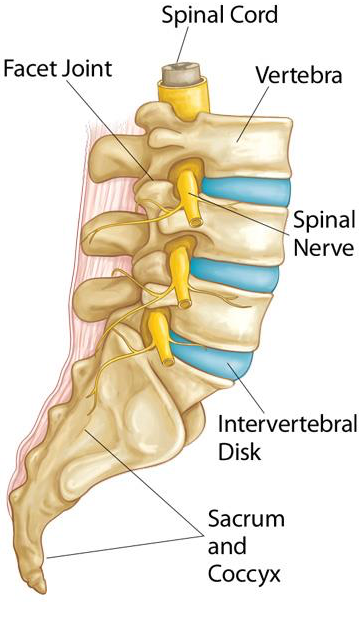
If we zoom in on the facet joints a little more, they are more than just two bones coming into contact with one another. Between the bones, there is cartilage, which allows for shock absorption with movement. There is also a cluster of ligaments, called a capsule, that surrounds the facet joint and produces a substance called synovial fluid, which helps to lubricate the joint. It is important to note that the stimulus for the production of synovial fluid is movement between the two bones that make up the joint.
The structure and orientation of the facet joints changes in different parts of the spine. Thankfully, the facet joints in the upper back (known as the thoracic spine) are very stable and are rarely injured, so I will only focus on the facet joints in the neck (cervical spine) and low back (lumbar spine) in this post. In the cervical spine, the facet joints are angled halfway between being parallel to the ground and parallel to a wall if you are standing, and they do not face the facet joints on the other side of the spine. In the lumbar spine, the facet joints are more or less straight up and down and face each other. This is important because the orientation has an impact on what movements you will need to perform to improve the motion of the facet joints. This video gives a good visualization of the orientation described above.
Facet Joint Injury
When involved in an accident, it is very common for the facet joints to be injured. This injury can occur as either compression or traction. To visualize this, imagine you are t-boned from the driver side. In this situation, your body will move to the right before your head, causing your head to bend to the left; this would cause compression on the left side and traction on the right. Regardless of the type of injury, the result is similar: the capsule and any muscles surrounding the joint will become stiff. As a result, that joint now moves less, meaning it produces less synovial fluid and less lubrication for the joint. This leads to a negative feedback loop, where less movement —> less synovial fluid production —> less joint lubrication —> less movement, etc.
There are a couple common symptoms that typically indicate dysfunction of the facet joints. The most common symptom is pain and decreased motion with movement to the side of the injury. For example, if the injury is in left side of your neck, you will have difficulty bending your head to the left, looking to the left, or extending your neck; a common way to describe this pain is as being “stuck.” You may also have pain with moving your head the other way, but you typically with have more motion in this direction and the pain will feel more like a stretch or pulling (this is due in part to muscle tightness on the side of the injured facet joint).
How to Recover From a Facet Joint Injury
If you remember what I said above, one of the causes of facet joint pain after an injury is the decrease in synovial fluid due to a decrease in motion. As a result, it is important to restore movement in the facet joint. This is easier said than done, since it is typically painful to move the spine when one or more of the facet joints is locked. However, it is almost always possible to move the head or low back a small amount with minimal to no pain, and it will almost always be easier to do if you are laying on your back.
When considering which movements to perform, we need to go back to the orientation of the facet joints. Since the facet joints in the neck are oriented forwards/backwards, as opposed to facing each other, the movements that will stimulate the most motion in the facet joints are flexion and extension. There are a couple ways to do this. In sitting, you can bring your chin as close to your chest as possible and then look up to the ceiling as far as you are comfortable. You can also perform an exercise called a chin tuck, which is where you essentially try and create a double chin; this is often less painful than trying to bring the chin to the chest and can also be performed on your back with your head resting on a bed or the ground. It is important to minimize pain with these exercises as much as possible, since reproducing pain can cause the muscles around the facet joint to tighten up even more, which will result in more pain and less range of motion.
The low back exercises are a little different. Since the facet joints are faced towards each other in the low back, the movement that allows the most motion in the facet joints is rotation. I like to have patients do this on their back with their knees bent and feet together. From here, gently rock your knees side-to-side, as far as you are comfortable going. If you have a swiss ball, that’s even better: you can put your lower legs on the ball with your knees bent 90 degrees and then rock side-to-side; this improves the orientation of the facet joints and makes the exercise more effective for producing movement in the facet joints.
Summary
Facet joints are an important, yet often overlooked, component of spinal pain following a car accident. These injuries most commonly occur in the neck and low back and result in decreased motion and pain with movement. One of the most important components of healing these joints is to restore movement in the facet joints, which is most easily done by performing repeated flexion and extension if the injury is in the neck and repeated rotation if the injury is in the low back. There are also many techniques that physical therapists and chiropractors can perform to help restore movement and heal the facet joints.
Western Slope Rehab and Performance is Here to Help
If you are struggling with injuries or have recently been in a motor vehicle accident, we can help. We are a physical therapy company that provides home-based orthopedic services in the Grand Junction, CO, area, as well as telehealth appointments throughout Colorado. If you would like to schedule a free consultation, you can call us as 970-462-9177, or fill out our contact form here.
If you found this post valuable, please like and share on our Facebook page, which is updated regularly with new content.