
I Have a Herniated Disc in My Low Back: How Can Physical Therapy Help?
A herniated disc is one of the most common injuries seen after car accidents. While herniated discs are relatively common in individuals without pain, it is also very likely that a car accident can cause a herniated disc due to the traumatic force involved in the accident. Physical therapy can often be very helpful for improving herniated disc symptoms after a car accident. In this article I will discuss the anatomy of the low back, why a herniated disc causes pain, and how physical therapy can help.
Anatomy of the Low Back
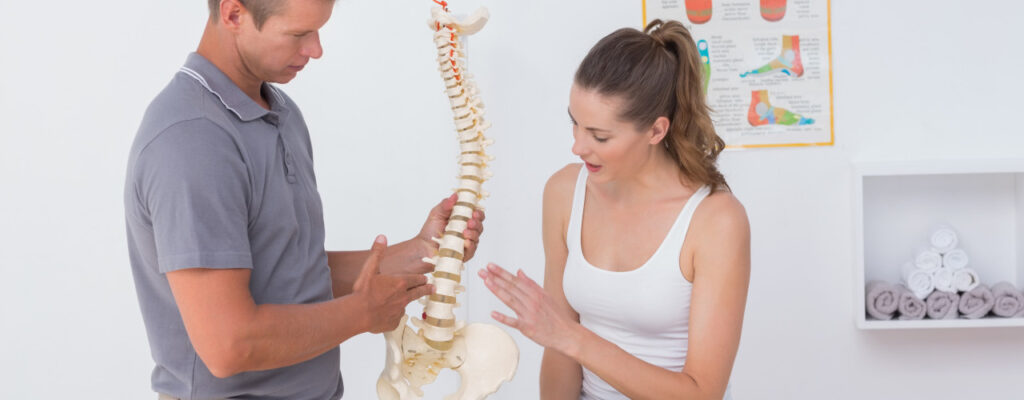
The low back, medically known as the lumbar spine, consists of 5 vertebrae, as well as the sacrum, also known as the tail bone. Between each set of vertebrae there is a disc, which provides cushioning between the vertebrae and helps to absorb force. In addition, there are also nerves that come out between each segment of the low back and descend into the legs. These are called nerve roots.
The arrangement of these structures can be seen well in the picture below. I want you to notice how the nerve roots sit behind and to the side of the discs; this will be important when we talk about how a herniated disc causes pain.
A disc is composed of 2 parts: a hard exterior called the annulus fibrosis, whose job is to maintain the shape of the disc, and a gooey inside called the nucleus pulposus, which helps to provide shock absorption. A herniated disc occurs when the goo inside the disc begins to either seep out of the hard exterior or put enough pressure on the exterior that it begins to lose its shape and become distended (commonly referred to as a bulging disc).
If you are interested in learning more about the anatomy of the lumbar spine, including why all the vertebrae and nerves are assigned names like L4 and S1.

Why Does a Herniated Disc Cause Pain?
The human body was not intended to sustain the force of a 4,000-pound vehicle moving at 45 mph, and while your car might be able to absorb a large part of that force, the sudden change in direction your body experiences can put enough force on the discs In the low back that they bulge out of place. When a disc bulges, the most common location for the bulge to occur is backwards and slightly to the side, aka posterolaterally, which is right where the nerve roots are. While it might seem foolish that your body is set up to have a disc bulge into a nerve, it’s actually the best place for it to go, because if it went straight backwards it would hit the spinal cord, and if it went forward or to the sides, it could cause damage to your organs.
When a disc herniates posterolaterally, the most common injury is pressure on the nerve root. The degree of injury varies based on the degree of the herniation: in mild cases, the disc herniates 1-2 mm and causes irritation of the nerve root, but does not apply enough pressure to it to cause changes in how the nerve functions. In more severe cases, the disc herniates 8+ mm and can cause actual damage to the nerve, resulting in changes in skin sensation and muscle function. Regardless of the severity of the disc herniation, if the nerve root is affected, it is common to experience pain in the back and the leg.
The other way a herniated disc can cause pain is through chemical interaction between the gooey inside of the disc and the environment outside of the disc. One of the purposes of the exterior of the cell is to prevent the gooey inside from interacting with the environment outside. It’s similar to receiving an organ transplant: when the body is confronted with an unknown substance (either another person’s organ or the inside of the disc), it starts an immune response to attack the unknown substance. This response to the substance, which is a form of inflammation, can cause pain.
How Can Physical Therapy Help if You Have a Herniated Disc?
Before I talk about the physical therapy techniques that can help a herniated disc, I would like to mention some good news: a significant number of herniated discs resorb back into their proper place in the spine. The frequency of resorption varies based on the size, with smaller herniations being more likely to resorb than larger ones. In addition, even if your disc does not fully resorb, it is still possible to be pain-free; as many as 2/3 of all Americans that do not have low back pain have a herniated disc.
One of the main goals of physical therapy is to identify limitations and improve them. With herniated discs in the low back, some of the most common limitations are decreased range of motion in the low back, tightness in the back muscles and hip flexors, and weakness in the abdominals and glutes. Therefore, some of the main goals of physical therapy will be to improve motion in your low back, decrease the tightness in your back muscles and hip flexors, and improve the strength of your abdominals and glutes.
Another technique that is commonly applied to disc herniations is the McKenzie Method. This treatment method can be applied to a variety of injuries, but the most common is for low back pain. In particular, a herniated disc usually causes a pain pattern that is improved by the performance of repeated extension exercises. Typically, the therapist will have you start on your stomach with your hands under your shoulders and then have you repeatedly press your chest into the air while keeping your hips on the table. This type of movement places pressure on the back side of the disc, creating room inside the disc so that the herniated portion can be drawn back in. In addition, this exercise is also a great way to improve the motion in your back if you are stiff from your car accident.
Summary
Herniated discs in the low back are one of the most common injuries caused by a car accident. One of the main causes of this pain is pressure on the nerves in the low back, which can cause pain in both the low back and the leg. Physical therapy can be very effective for treating herniated discs and typically focuses on treating the impairments the therapist finds, as well as using specific techniques like the McKenzie Method.
Western Slope Rehab and Performance is Here to Help
If you are struggling with injuries or have recently been in a motor vehicle accident, we can help. We are a physical therapy company that provides home-based orthopedic services in the Grand Junction, CO, area, as well as telehealth appointments throughout Colorado. If you would like to schedule a free consultation, you can call us as 970-462-9177, or fill out our contact form here.
If you found this post valuable, please like and share on our Facebook page, which is updated regularly with new content.