How to Recover from a Bad Arm Bar

Arm bars are one of the most common submissions in jiu jitsu and mixed martial arts, and few injuries can be more gruesome than an arm bar that goes a little too far. Thankfully for most of us recreational athletes, we don’t let it get to the point where we are at risk of dislocating our elbow, but there are certainly times where it can be stretched a little past comfort. Today I’m going to explore what you can do to get back on the mats as soon as possible when this happens (note: I will be focusing on an armbar where there is no dislocation; if you dislocate the elbow, there is a lot more you need to worry about).
Elbow Anatomy
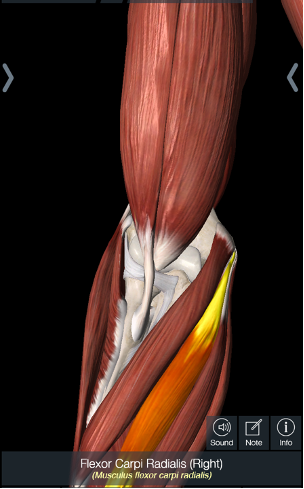
The elbow is made up of three bones: the humerus, ulna, and radius (see picture below). In regard to the arm bar, the structures you need to care about the most are the ulnar collateral ligament (UCL), biceps musculature, and forearm flexor musculature. The UCL attaches from the inside of the humerus to the inside of the ulna, and while it is primarily keeps any “gapping” from occurring in the inside of the elbow (this is Tommy John ligament that baseball players injury, so think about a pitching motion), it also helps to prevent hyperextension of the elbow. The biceps is the primary muscle group that allows you to flex the elbow, but is assisted by the forearm flexors, which also cross the elbow (see pictures).



Arm Bar Mechanism of Action
An arm bar works by placing hyperextension on the elbow with the forearm in either a neural (thumb up) or supinated (palm up) position. When the hyperextension force is applied, it puts pressure on the joint, which thankfully is one of the most stable joints in the body and is pretty difficult to dislocate. It also puts pressure on the surrounding ligaments, particularly the UCL. In addition, the forearm flexors and elbow flexors often times reflexively contract in an attempt to prevent the elbow from going into hyperextension. In a study that looked at 5 competitors from the Gracie Elite gym that were injured from being caught in an arm bar, MRIs found that all 5 had ruptured their UCL and either fully or partially ruptured the forearm flexor tendon.
How to Recover from an Arm Bar
The most important thing to do after sustaining a nasty arm bar is to prevent hyperextension from happening again. There are a couple options here. The first is to get an elbow brace, such as Bauerfeind’s. The biggest problem with a brace is that they are not particularly great at preventing hyperextension without having clunky supports, which you can’t really use when rolling. My preferred option is a taping technique like this one. Tape provides a much better mechanical restraint against hyperextension, if done properly, and is sleek enough that you can put a rash guard over top of it.
Once you have protection of the elbow taken care of, you will want to do some work on the biceps and forearm flexors to reduce the tension within them. My personal favorite technique is dry needling, since it reduces tone while bringing blood flow to the area to help with healing the muscles and ligaments. If you do not have access to a therapist that does dry needling, you can also try massage or cupping to obtain similar results.
Damaged ligaments and muscles (if not completely torn) typically take 6-8 weeks to heal, but you may notice continued pain or limitations after this point. Typically, this is not due to the damaged ligament at this point, unless you have re-injured it. Rather, there may be some swelling within the elbow joint from subtle re-aggravation of the injury, or the surrounding musculature may still have increased tone. In both situations, it is a good idea to find a medical professional that is able to discern what exactly is causing the problem (as a physical therapist, I am biased towards my profession when it comes to who to see). It is also possible that you have a complete tear of a ligament, in which case you may need an MRI or similar imaging to determine the extent of the damage.
I hope you found this post on arm bars informative. If you are having difficulty recovering from an arm bar, it is worth seeing a physical therapist for an additional opinion and treatment to get you back on the mats. If you live in the Grand Junction area, feel free to give me a call for a free consultation to see what we can do!