
Guide to Using Blood Flow Restriction Following ACL Reconstruction
Blood flow restriction (BFR) training has been gaining popularity in health and fitness circles over the past 10 years, and for good reason. It has many purported uses, from improving aerobic performance and endurance to helping individuals recover from injuries. In this post, I will focus on how to use blood flow restriction training when recovering from injury, specifically from an ACL reconstruction.
What is Blood Flow Restriction Training?
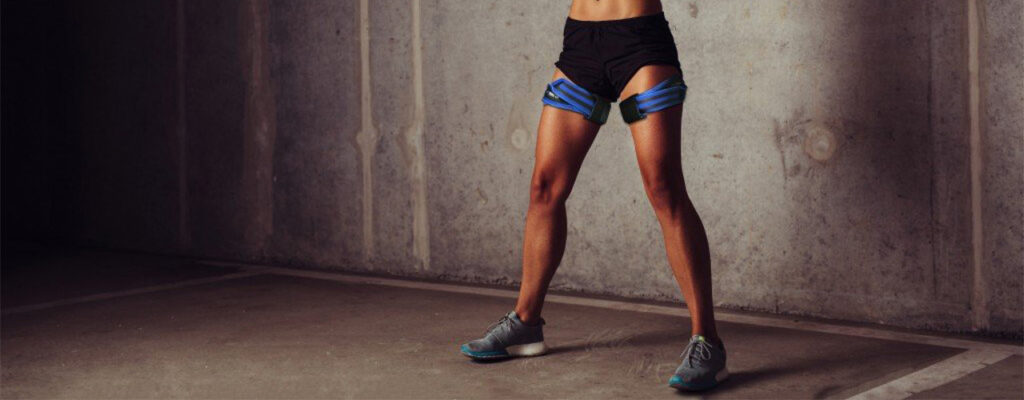
BFR training is a general term used to describe the process of exercising while partially occluding the supply of blood to one of the extremities. This is typically performed with special bands – similar to a blood pressure cuff – than can be incrementally inflated to create the desired amount of occlusion. This process was first described in the scientific literature in 1998 and the research has increased exponentially since then.
How Does BFR Work?
When the BFR band is applied to an extremity, it is pumped up until it occludes a specific percentage of the blood flowing through the arteries into the given extremity; the occlusion percentage typically ranges from 30-80%, depending on the extremity being occluded and the goals of using BFR. When the band is pumped us, it not only causes the amount of arterial blood flow to decrease by a certain amount, but it also prevents venous return (the flow of blood through the veins towards the heart), causing that blood to pool in the extremity.
The combination of these two effects – decreasing arterial blood flow and stopping venous return – has many potent effects. In regard to increasing muscle size, BFR works through 3 main mechanisms: cell swelling, metabolic-induced fatigue, and hormone release.
When blood pools in the extremity, some of that blood is pushed into the muscle, causing localized swelling of the muscle. This localized swelling results in a decrease in protein breakdown in the muscle and/or an increase in protein synthesis (the research isn’t exactly sure which one). This also results in the accumulation of metabolites (byproducts of muscle function) in the muscle, which leads to faster fatigue of lower-order muscle fibers (the fibers that are initially recruited to perform low-intensity muscle function) and the recruitment of higher-order muscle fibers (the fibers that are typically only recruited during high-intensity muscle function).
The accumulation of these metabolites results in the systemic release of growth hormone and testosterone, which stimulates muscle growth. Research has found that the degree of release of these hormones is similar between individuals performing low-load exercise with BFR and individuals performing high-load exercise without BFR. It is also likely that the production of reactive oxygen species, and their effects on satellite cells within the muscle, also plays a role, but the research on this mechanism is inconclusive.
How to Use BFR Following ACL Surgery
Now that we have an understanding of how BFR leads to improvements in muscle mass and strength, let’s look at how to use BFR when recovering from ACL surgery.
Before we look at the use of BFR post-surgery, let’s look at its uses pre-surgery. Since the vast majority of individuals who tear their ACL will have significant decreases in quadriceps muscle mass and strength following their injury due to pain and inactivity, it is important to optimize strength and muscle mass as much as possible prior to surgery. Research has shown that the use of BFR prior to ACL surgery results in improved knee extensor endurance, muscle stem cell levels, and myostatin levels.
Following surgery, BFR is very effective in the early stages of recovery, since this is the phase when you are unable to perform high-intensity exercise. One study found that even if you don’t exercise with the BFR cuff on, it can still be beneficial. This study applied the BFR cuff 2x/day, with each session consisting of 5 minutes on and 3 minutes off for 5 consecutive sets. The protocol began on the 3rd day after surgery and continued until the 14th day. This study found that the use of BFR, even without exercising during its application, significantly decreased the amount of atrophy that occurred in the quadriceps and hamstrings by 60% compared to a control group. The one thing I don’t like about this study is that the occlusion pressure applied by the device was not normalized to a percentage of the pressure needed to fully occlude the arteries. Instead, they applied 180 mmHg of pressure to all participants, which probably coincides to 50-70% occlusion (there are a lot of factors that go into this number, including the width and brand of the cuff, as well as differences between individuals, which makes extrapolation of the percentage difficult).
As expected, however, BFR works better when accompanied with exercise. One study examined the use of BFR when performing leg press exercises in individuals at least 2 weeks post-surgery. The BFR subjects performed the leg press 2x/week using a rep scheme of 30, 15, 15, 15 (30s rest between sets) at 30% of the pt’s 1-rep max (1RM) with an occlusion pressure of 80%; the control group performed the leg press 2x/week with a rep scheme of 3×10 at 70% of the estimated 1RM. This study found that the BFR group had better outcomes in regard to pain, swelling, knee ROM, and self-reported physical function compared to the control. Both groups exhibited similar improvements in quadriceps muscle mass and strength, although the control group’s improvement in strength was slightly better than the BFR group (but not statistically significant). In my personal recovery, I will begin doing higher-load training without BFR well before the 10-12-weeks post-op end date of this study, which will hopefully allow me to maximize strength improvements during this period when compared to the BFR group in this study.
Another potential application of BFR is to combine its use with neuromuscular electrical stimulation (NMES). NMES is commonly used in the first weeks after ACL surgery to assist with contraction of quadriceps muscle while the patient still has difficulty recruiting it themselves due to inhibition from swelling. While no studies have been performed looking at the combination of BFR and NMES following ACL surgery, studies have been done for other parts of the body, which found that the combination of BFR and NMES was better than NMES alone. Personally, I will be using this combination for the first several weeks following my ACL reconstruction, starting 3 days post-surgery. (Why not earlier? It would probably be fine, but I have yet to come across a study that began using BFR or NMES early than 3 days post-surgery, so I’m trying not to push my luck).
Random Tidbit
One interesting finding I came across in my research is that taking rapamycin during the same time period that BFR is being used blunts the response of BFR by inhibiting the increase in protein synthesis. This is likely because rapamycin interferes with mTOR, which is responsible for activating some of the signaling pathways involved in protein synthesis. Rapamycin has become a molecule of interest in the anti-aging world, which I pay a good of amount of attention to, and this finding will likely become increasingly relevant as more people begin to take rapamycin as an anti-aging drug. This is likely an area that should be addressed with patients – especially elderly patients undergoing THAs, TKAs, and rotator cuff repairs – as their results with BFR may be limited by the use of rapamycin.
Summary
When performed correctly, BFR is a very safe modality to use before and after ACL surgery to improve muscle mass and strength in the leg while minimizing pain and swelling. It is important to use a device that is capable of determining your body’s specific occlusion pressure, as this will allow you to choose the correct occlusion pressure to use when exercising. BFR has benefits even when exercise is not performed concurrently, although the results are better if BFR and exercise are combined. BFR can also likely enhance the benefits of NMES when used together following ACL reconstruction.
Western Slope Rehab and Performance is Here to Help
If you are struggling with injuries or have recently been in a motor vehicle accident, we can help. We are a physical therapy company that provides home-based orthopedic services in the Grand Junction, CO, area, as well as telehealth appointments throughout Colorado. If you would like to schedule a free consultation, you can call us as 970-462-9177, or fill out our contact form here.
If you found this post valuable, please like and share on our Facebook page, which is updated regularly with new content.